Best Interactive Cat Toys for Indoor Cats in 2026
Updated 2026-08-18 · HappyPawPicks Editorial
HappyPawPicks is reader-supported. Some of our recommendations include affiliate links. If you buy through them, we may earn a commission — at no extra cost to you. As an Amazon Associate I earn from qualifying purchases. Our editorial process is independent and never influenced by commissions.
Indoor cats aren’t wired to lounge
The marketing around cats says “low maintenance,” but the animal itself says otherwise. A cat is a predator built to stalk, pounce, climb, and patrol. Take all of that away and replace it with a couch, and the instincts don’t disappear — they misfire. That’s why the bored indoor cat isn’t lazy, it’s under-stimulated, and the symptoms look like behavior problems: shredded curtains, over-grooming to bald patches, attention-seeking at 3 a.m., and gradual weight gain.
Interactive toys are the outlet. They don’t just burn energy; they give the hunting circuit somewhere to go. The American Association of Feline Practitioners ties enrichment play directly to fewer unwanted behaviors toward people and other pets, and the veterinary consensus is clear that sedentary indoor cats face higher risks of obesity, diabetes, and even arthritis (catvets.com).
Build the trio
You don’t need a wall of toys. Three categories do the job:
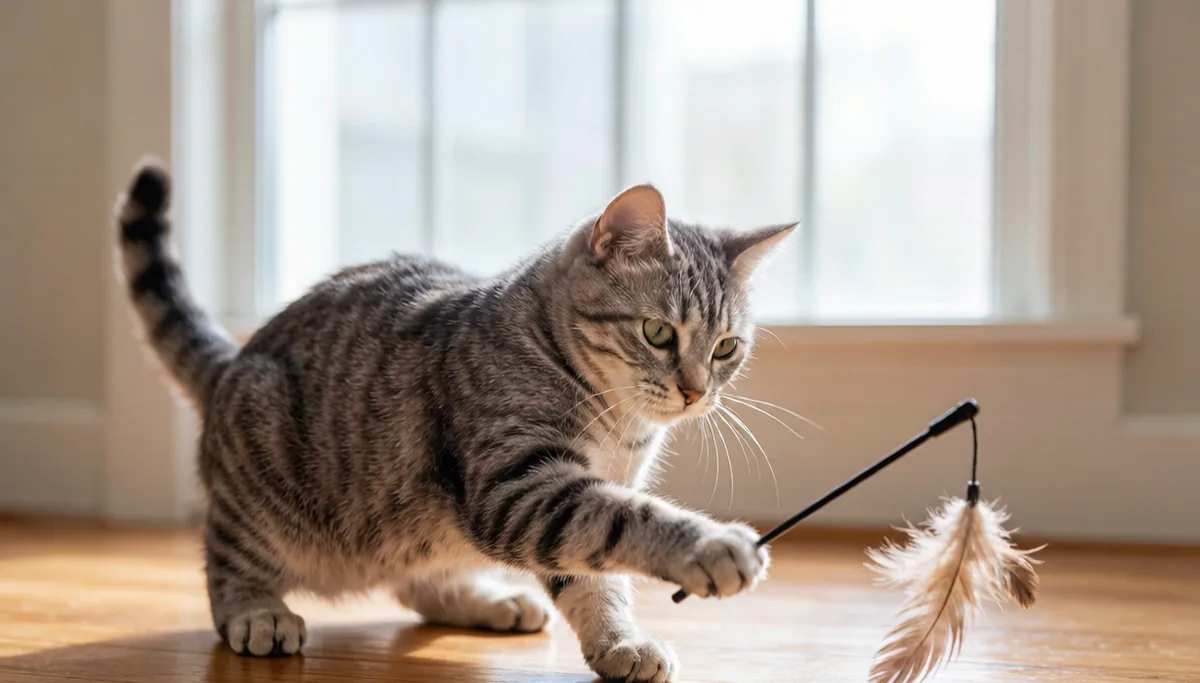
1. A wand or teaser for the hunt. A fishing-pole-style toy with feathers or a small prey shape triggers stalking and pouncing. The human holds the other end, so this is bonding time too — you’re the accomplice in the hunt. The one rule: let the cat catch the toy every few minutes. A hunt that never ends with a catch leaves the cat frustrated, not satisfied.
2. A puzzle or treat feeder for the brain. Food puzzles — from a plastic bottle with holes to a spiral treat tower — make the cat work for a portion of kibble. The Journal of Feline Medicine and Surgery has documented benefits including weight loss, reduced anxiety, and fewer attention-seeking behaviors. Slowing a fast eater also reduces vomiting. This is the toy that works while you’re busy.
3. A motion toy for solo time. Robotic prey, a ball track, or a rechargeable smart ball gives independent play. Studies cited by International Cat Care find adult cats play harder and longer with toys that resemble real prey and move unpredictably. These keep a cat moving when you’re on a call.
How much, how often
Aim for 2–4 sessions of 5–15 minutes a day, plus forage enrichment available whenever you’re out. That mirrors natural hunt-bout rhythm — intense bursts, not marathons. Kittens and high-energy breeds want 30–45 minutes; seniors do well with 10–15 minutes of gentler play. Consistency beats duration: a reliable dawn and dusk session fits a cat’s crepuscular clock better than one random long playdate.
The rotation trick
The reason a cat ignores a toy by day three isn’t the toy — it’s the familiarity. Novelty drives play. Keep two or three toys out, store the rest, and swap every few days. The “old” ones feel new again, and you’ve spent nothing. End laser play with a physical toy to catch, and make sure motion toys actually move like prey rather than sitting still.
Safety you can’t skip
Wand strings, feathers, and any battery-compartment electronic toy should be put away when you leave — cats ingest strings and chew batteries, both emergencies. Ball tracks, puzzle feeders, and sturdy crinkle toys are safe for solo time. Check everything for worn fabric or loose parts weekly and replace anything with exposed stuffing. Enrichment should never become a vet trip.
Keep reading
- Best Cat Scratchers — give the climbing and scratching instinct its own outlet.
- Best Cat Trees — vertical territory that cools conflict in multi-cat homes.
- Catnip Safety and Uses — the scent that turns a dull toy into a event.
Frequently asked questions
Are interactive toys really necessary for indoor cats?
For a cat that never goes outside, yes — they're closer to preventive care than entertainment. Cats are natural hunters, climbers, and explorers, and an indoor life removes those outlets. Without replacement, boredom shows up as scratching furniture, over-grooming, aggression, and weight gain. The American Association of Feline Practitioners notes that enrichment play reduces unwanted behavior toward people and other pets, and sedentary cats are more prone to obesity, diabetes, and arthritis. Toys that mimic hunting give the instinct a safe place to go.
What types of interactive toys should I have?
Three categories cover most cats: (1) a wand or teaser that mimics prey movement for short, human-led chase sessions; (2) a puzzle or treat-dispensing feeder that makes the cat work for food and slows fast eaters; and (3) a motion toy — robotic prey, a ball track, or a smart ball — for independent play when you're busy. Mechanical 'prey' that moves unpredictably gives indoor cats hunting enrichment while keeping wildlife safe. Match the type to your cat: confident cats want high-energy chase, shy cats do better with slow, predictable wands.
How much play does an indoor cat need?
Roughly 2–4 short sessions of 5–15 minutes each day, plus leave-and-forage enrichment available whenever you're out. That mirrors a cat's natural hunt-bout rhythm — a few intense bursts, not one long session. Kittens and high-energy breeds (Bengals, Abyssinians) need more, often 30–45 minutes of active play; seniors do fine with 10–15 minutes of gentler engagement. The key is consistency and ending each wand session with a 'catch' so the cat feels the hunt resolved.
Why does my cat ignore toys after a few days?
Because novelty drives play, and a toy left out forever stops being novel. Rotate two or three toys every few days — put some away, bring others out — and the old ones feel new again. Also end laser play with a real toy to catch, since a cat that never 'catches' gets frustrated. And make sure the toy actually moves like prey: skitter, rustle, and disappear, rather than sitting still. A bored cat is often a cat whose toys stopped changing.
Are interactive toys safe to leave with my cat unsupervised?
Not all of them. Wand toys with strings, feather toys, and any electronic toy with a battery compartment should be put away when you leave — cats can ingest strings, feathers, or chew into batteries, which is an emergency. Ball tracks, puzzle feeders, and sturdy crinkle toys are safer for solo time. Check toys regularly for worn fabric or loose parts and replace anything with exposed stuffing. The goal is enrichment, not a trip to the emergency vet, so supervise the risky ones and leave the safe ones out.
References: American Association of Feline Practitioners, Hill's Pet: Interactive Cat Toys .