Best Slow Feeder Dog Bowls in 2026: What They Fix, and What They Don't
Updated 2026-08-10 · HappyPawPicks Editorial
HappyPawPicks is reader-supported. Some of our recommendations include affiliate links. If you buy through them, we may earn a commission — at no extra cost to you. As an Amazon Associate I earn from qualifying purchases. Our editorial process is independent and never influenced by commissions.
What a slow feeder actually does
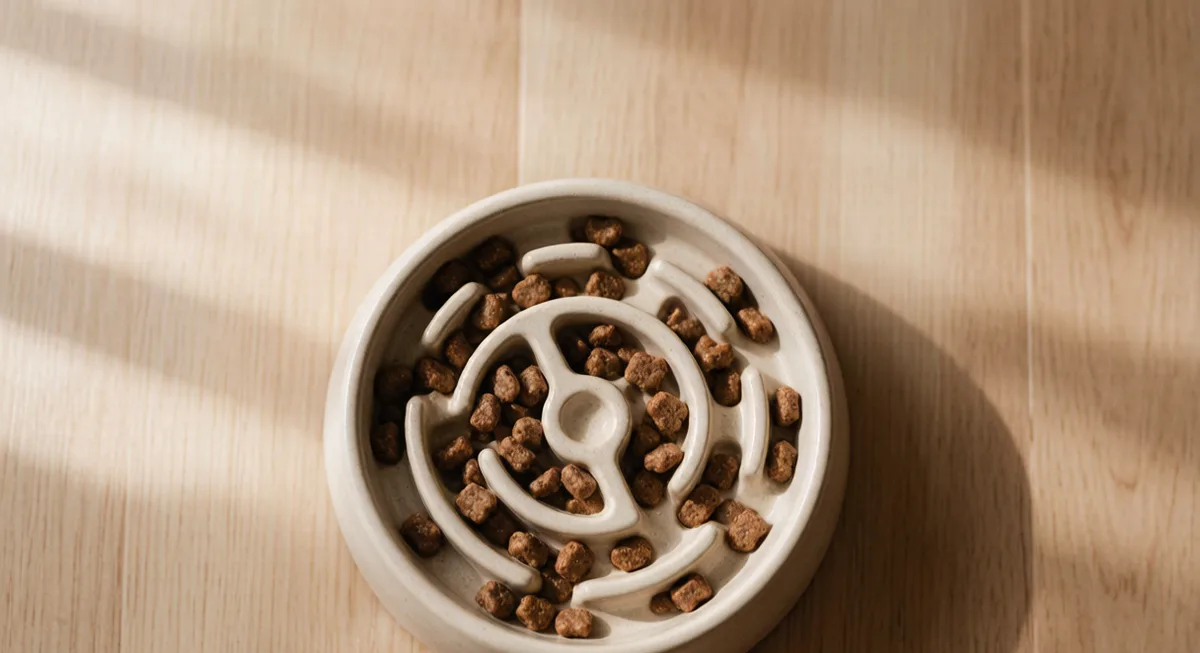
It puts obstacles between your dog and the food. That is the whole mechanism, and it is more useful than it sounds.
A dog that inhales a bowl in twenty seconds swallows a large volume of air with it. The immediate consequences are unglamorous and common: burping, hiccups, regurgitating an undigested cylinder of kibble on the rug ten minutes later, and a dog that is hungry again almost immediately because nothing about the meal registered as a meal.
A maze bowl fixes those things reliably. Where the marketing overreaches is the next claim.
The bloat question, answered honestly
Gastric dilatation-volvulus is the reason most people buy these bowls, so it deserves a straight answer rather than a hedge.
The ACVS describes GDV as “a rapidly progressive life-threatening condition of dogs that requires immediate medical attention” and notes the condition is multifactorial but “commonly associated with rapid ingestion of large meals.” Its published list of associations covers dogs that:
- have a deep chest (increased thoracic height-to-width ratio)
- are fed a single large meal once daily
- are older
- are related to other dogs that have had the condition
ACVS adds that elevated feeding, previous spleen removal, large or giant breed size and stress have also been suggested as possible contributors, and cites a 2006 study finding that dry foods listing oils among the first four ingredients predispose high-risk dogs. Reported mortality is approximately 15%.
Read that list carefully and the honest conclusion falls out: a slow feeder addresses one item. Chest shape, genetics and age are not purchasable. What is free is the second item on the list — feed two or three smaller meals rather than one large one, which is also the long-term dietary management ACVS describes for dogs that have already had surgery.
There’s a second detail worth flagging because it contradicts advice that circulates widely: elevated feeding appears on the suggested-risk side of that page, not the protective side. If you’ve read that raised bowls prevent bloat, that claim does not match what the surgical college publishes. We’ve written separately about when elevated bowls genuinely help — arthritis and certain medical conditions — but “bloat prevention” is not on that list for a healthy deep-chested dog.
And if you own a Great Dane, Weimaraner, St. Bernard or setter, the intervention with real evidence behind it is prophylactic gastropexy, which many veterinary surgeons now recommend for at-risk breeds and which can often be done during spay or neuter surgery. That is a vet conversation, not a shopping decision.
What separates a good slow feeder from a gimmick
| Feature | Why it matters | What to avoid |
|---|---|---|
| Ridge height | Short ridges are decorative; food should sit between walls, not on a textured floor | Bowls where kibble rests on top of the pattern |
| Groove width vs kibble | Grooves must be wider than the kibble but narrow enough to require work | Large-breed kibble in fine spiral channels — it jams |
| Non-slip base | A determined dog will push a light bowl across the kitchen and defeat the whole design | Lightweight plastic with no rubber ring |
| Cleanability | Wide, rounded channels rinse; sharp corners hold residue | Intricate mazes if you feed wet food |
| One-piece moulding | No seams for food to hide in | Inserts that lift out and trap moisture underneath |
| Rounded edges | Enthusiastic dogs press their muzzle in hard | Hard plastic ridges with sharp tops |
The one specification nobody prints on the box is the one that matters most: the relationship between your kibble size and the groove width. A maze that transforms mealtime for a Labrador on small kibble does nothing for a Dane on jumbo kibble, because the pieces simply sit on top of the pattern. Match them, or the bowl is decoration.
Match the pattern to the dog
- Deep-chested large breeds — deep maze, heavy or weighted base, and floor-level placement unless your vet has said otherwise.
- Flat-faced breeds (pugs, French bulldogs, boxers) — shallow, wide-lobed patterns only. A deep narrow maze is a design they physically cannot solve.
- Puppies — a gentle pattern is plenty; the goal is establishing a pace, not building an obstacle course.
- Wet or raw feeders — wide open channels, dishwasher safe, no sharp internal corners.
- Bowl-shovers — weight and a rubber base beat cleverness every time.
- Multi-dog households — feed in separate rooms. Competition speed is a behaviour problem and no bowl fixes it.
Mainstream options are inexpensive and easy to find: Outward Hound slow feeders are the pattern most people picture, with a wide range of maze depths and sizes, and Neater Pets bowls cover the spill-control and mess-containment end. Match the size to your dog’s kibble before you match it to your kitchen.
The free upgrades
Before or alongside the bowl:
- Split the meal. Two or three smaller meals instead of one large one. This is on the ACVS risk list and it costs nothing.
- Feed before exercise, not after — and leave a gap. A settled dog eats more calmly than one that has just come in from the park.
- Feed separately in multi-dog homes. Competition is the most common cause of speed-eating we see described, and it is fully solvable with a door.
- Use a muffin tin. Portion kibble across six cups. It is free, it works, and it tells you within one meal whether a slow feeder will help before you spend anything.
- Know the emergency signs. Retching without producing anything, a distending abdomen, drooling, pacing and looking at the flank. ACVS is unambiguous that this is an immediate-attention situation and that outcomes worsen with delay.
Bottom line
Buy a slow feeder because your dog gulps, throws up after meals or finishes dinner before you’ve put the scoop away. Those are real problems and a $15 moulded maze genuinely solves them.
Do not buy one as bloat insurance. GDV is multifactorial, eating speed is one factor among several, and the free half of the fix — smaller, more frequent meals — is the part most owners skip. Get the bowl, split the meals, keep the bowl on the floor unless your vet says otherwise, and learn the emergency signs. That combination is worth far more than any single product on the shelf.
FAQ
- Q: Do slow feeder bowls prevent bloat? A: No. They address ingestion speed, which ACVS lists as commonly associated with GDV — but chest conformation, genetics, age and once-daily feeding are also on that list. Slowing eating helps; it is not prevention.
- Q: Are raised dog bowls bad for bloat? A: ACVS lists elevated feeding among factors that have “been suggested” to increase incidence. That’s not a settled finding, but it means raising the bowl isn’t a neutral choice for a deep-chested dog.
- Q: How much slower do slow feeder bowls make a dog eat? A: It depends on maze depth versus kibble size. Time one meal each way — if the difference is under a minute, the pattern is wrong for your kibble.
- Q: Can I use a slow feeder bowl for wet food? A: Yes, with wide rounded channels and a dishwasher-safe body. Narrow spiral mazes and wet food are a cleaning trap.
- Q: Are slow feeder bowls safe for flat-faced breeds? A: Use shallow, wide-lobed patterns. Deep narrow mazes are unreachable for brachycephalic dogs, and a flat tray works nearly as well.
- Q: Slow feeder bowl or puzzle feeder? A: Slow feeder for gulping, puzzle feeder for boredom. They solve different problems and plenty of dogs need both.
Keep reading
Frequently asked questions
Do slow feeder bowls prevent bloat?
They address one contributing factor, and it would be dishonest to claim more. The American College of Veterinary Surgeons describes gastric dilatation-volvulus as multifactorial but "commonly associated with rapid ingestion of large meals," and its risk list includes being fed a single large meal once daily, having a deep chest, being older, and being related to affected dogs. A slow feeder targets exactly one item on that list — ingestion speed — and does nothing about chest conformation, genetics or age. Splitting food into two or three smaller meals a day addresses a second item and costs nothing. If you own a high-risk breed, the conversation to have is with your vet about prophylactic gastropexy, not with a retailer about bowls.
Are raised dog bowls bad for bloat?
The evidence is not reassuring, and it runs against a lot of popular advice. In its list of associations for GDV, ACVS states that elevated feeding "has also been suggested" as something that may increase the incidence of the condition, alongside prior spleen removal, large or giant breed size, and stress. That is a suggestion rather than a settled finding, but it means raising the bowl is not a neutral choice for a deep-chested dog. Elevated bowls still make sense for arthritic or megaesophagus dogs where a vet has recommended them. For a healthy Great Dane, the default should probably be floor level.
How much slower do slow feeder bowls actually make a dog eat?
It varies enormously with maze depth and kibble size, which is why generic multiplier claims should be treated with suspicion. What you can verify at home in one meal: time the dog with the normal bowl, then time the same portion in the slow feeder. If the difference is under a minute, the maze is too shallow or the kibble is too large for the grooves, and you have bought a decorative bowl. A well-matched feeder typically turns a frantic 30-second inhale into several minutes of deliberate work.
Can I use a slow feeder bowl for wet food?
Yes, but choose the pattern for cleaning rather than for cleverness. Wet food packs into narrow spiral channels and dries into cement, which turns a hygiene win into a hygiene problem. Look for wide, rounded, open grooves and confirm the bowl is dishwasher safe. Sharp-cornered mazes are for dry kibble only unless you enjoy scrubbing.
Are slow feeder bowls safe for flat-faced breeds?
Use them, but pick the pattern carefully. Brachycephalic dogs like pugs and French bulldogs physically cannot reach into deep narrow channels, so an aggressive maze either frustrates them or pushes them to shove their face in harder. Shallow, wide-lobed patterns work. So does the low-tech alternative of spreading kibble on a large flat tray, which slows eating without demanding a long muzzle.
What's better, a slow feeder bowl or a puzzle feeder?
They solve adjacent problems and it is worth being clear which one you have. A slow feeder is a bowl that makes eating physically slower; a puzzle feeder makes the dog think to release food. If your dog gulps, a slow feeder is enough. If your dog eats at a normal speed but is bored, destructive or under-stimulated, a puzzle or a snuffle mat does more. Many dogs benefit from both — a slow feeder for breakfast when you're rushing, a puzzle for the meal that has to occupy them.
References: American College of Veterinary Surgeons: Gastric Dilatation-Volvulus (GDV) .