Best Cat Carriers for Travel in 2026: Flying, Driving, and What Actually Passes
Updated 2026-08-10 · HappyPawPicks Editorial
HappyPawPicks is reader-supported. Some of our recommendations include affiliate links. If you buy through them, we may earn a commission — at no extra cost to you. As an Amazon Associate I earn from qualifying purchases. Our editorial process is independent and never influenced by commissions.
The mistake almost everyone makes
People shop for a cat carrier the way they shop for a handbag: capacity, colour, how it hangs. Then they discover at the gate that it is an inch too tall for the under-seat space, or they belt it into the back seat and quietly assume the strap is doing something useful.
There are two distinct problems here, and one product rarely solves both.
Flying is a dimensions problem. You are not being judged on build quality. You are being judged on whether the carrier slides fully under the seat in front of you.
Driving is a physics problem. In a crash, an unsecured carrier becomes a projectile, and a soft-sided bag has nothing in it to resist deformation.
Buy for whichever trip you actually take. If you take both, buy two — it costs less than one vet visit.
Flying in-cabin: the numbers that matter
Delta’s pet travel page is unusually specific, and because most U.S. carriers converge on similar under-seat geometry, it is a reasonable planning baseline:
- Maximum dimensions are set by the aircraft, not the airline. The page states the maximum in-cabin kennel size is determined by the aircraft dimensions of your flight, since under-seat space varies.
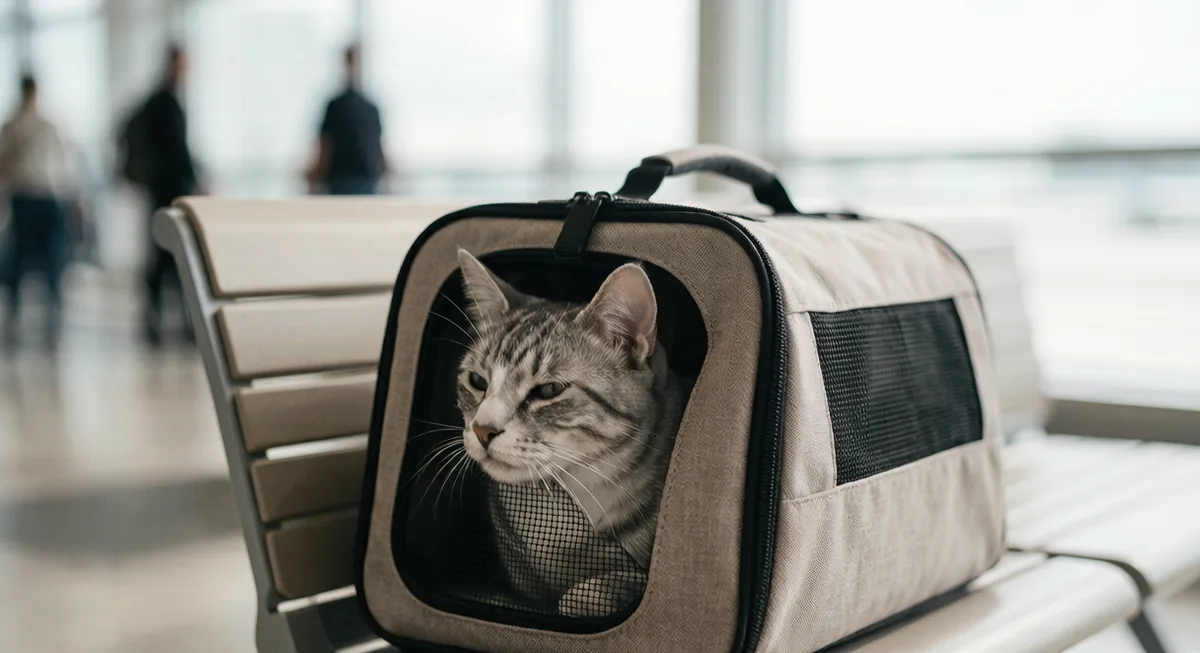
- The recommended soft-sided size is 18” x 11” x 11” because it fits most aircraft types.
- Ventilation is specified: leak-proof, with ventilation openings on three sides for domestic travel and four sides for international.
- The cat must be able to move. Your pet has to fit comfortably and be able to move around “without touching or sticking out from the sides.”
- The carrier must fit fully under the seat directly in front of you — and it does not replace your personal item allowance in the way people assume, since you’re permitted one kennel plus one personal item or carry-on.
Two practical consequences follow.
First, measure your cat, not just the box. A 12-pound cat that lies flat is a different proposition from a 12-pound cat that insists on standing. Measure shoulder height while standing and length nose-to-tail-base, then compare against the carrier’s interior dimensions, which are always smaller than the advertised outside numbers.
Second, soft sides are a feature, not a compromise. A rigid box at exactly 18 x 11 x 11 either fits or it does not. A soft carrier gives you an inch of forgiveness when the under-seat bar is in an awkward place.
What flying costs
Budget the fee before you fall in love with the idea. Delta charges $150 USD each way within the U.S., Canada, Puerto Rico and the U.S. Virgin Islands for tickets issued on or after April 8, 2025, and $200 for international travel. Pets are also barred from certain cabins and seats — no bulkhead, no exit row, no flat-bed seats — and some destinations, including Hawaii and Australia, are off the table entirely.
The security checkpoint
The single most underestimated moment of the trip: you must take your cat out of the carrier at the security checkpoint while the empty carrier is screened. Put a properly fitted harness and leash on before you leave the house. This is not optional equipment for air travel, whatever the carrier’s product page implies.
Driving: crash certification is a short list
Here is where most buying guides get vague, so let’s be blunt.
The Center for Pet Safety publishes a list of independently tested CPS Certified products. As of this writing, the certified carriers are the Away Pet Carrier, the Diggs Passenger Carrier, the PawsInCar Expandable Pet Carrier and the PawsInCar Multi-Window Cat Backpack Carrier, alongside rigid travel kennels from Gunner, Lucky Duck and Cabela’s.
That is the list. A carrier not on it is not automatically unsafe — but no independent body has verified how it behaves in a collision, and “crash tested” on a box means whatever the manufacturer wants it to mean.
If you drive with your cat regularly, the useful hierarchy is:
- A certified carrier, secured per the manufacturer’s instructions.
- A rigid carrier on the floor behind a front seat, where it cannot travel far.
- A soft carrier on the back seat with the seatbelt threaded through the strap loop — better than loose, and not remotely the same as certified.
- Loose on the passenger seat. Please, no.
What to look for, in priority order
- Top loading, or top-and-front. The most useful feature for a cat that plants all four feet at the door. You lower them in; you do not negotiate.
- A hard base. Even in a soft carrier, a rigid floor panel stops the sag that makes cats brace and panic.
- Ventilation on multiple sides. Required by airlines, and it keeps the interior temperature sane in a warm car.
- A seatbelt pass-through or strap loop. Non-negotiable for driving.
- Washable, removable lining. Assume at least one accident. Assume it happens on the longest leg.
- A clip point inside for a harness lead, so an opened door isn’t an open door.
What matters less than the marketing suggests: wheels (rarely usable in a cabin aisle), expandable side pods (great in a hotel room, useless under a seat, and not permitted in flight), and backpack styling for anything but short walks.
Picking by scenario
| Your trip | What to buy | Why |
|---|---|---|
| Occasional vet runs | Rigid top-loading carrier | Easy loading, easy cleaning, belts down in the car |
| Regular car travel | CPS-certified carrier or rigid kennel | Only category with independent crash verification |
| Flying in-cabin | Soft-sided, ~18 x 11 x 11, 3–4 vented sides | Matches airline under-seat guidance |
| Moving house | Rigid carrier + a settled “home base” room | Transport is the short part; adjustment is the long part |
For the vet-and-car use case, familiar mainstream options are easy to find: Sherpa soft carriers are a long-standing airline-oriented choice, Sleepypod builds carriers designed around in-car use, and Petmate covers the budget rigid end. Check the current dimensions on any listing against your airline’s guidance, and check the CPS list directly if crash performance is your deciding factor.
Bottom line
A cat carrier is not one product. It is two: a box that fits an under-seat space, and a box that survives a collision. Airlines will tell you the first number — Delta’s 18” x 11” x 11” recommendation is a sound planning figure — and only the Center for Pet Safety will tell you the second. Everything else on the box is upholstery.
Get the carrier out of the closet this week, leave it open in the living room, and feed a few meals in it. The gear matters less than whether your cat has already decided the box is fine.
FAQ
- Q: What size cat carrier is allowed on a plane? A: There is no universal number — the cap is the under-seat space on your specific aircraft. Delta recommends a soft-sided kennel no larger than 18” x 11” x 11” because it fits most aircraft types, and requires it to be leak-proof with ventilation on three sides domestically, four internationally.
- Q: Are soft or hard cat carriers better? A: Soft for flying, rigid for driving. Soft-sided compresses into a variable under-seat space; rigid holds its shape in a collision. If you do both regularly, own both.
- Q: Which cat carriers are crash tested? A: Only those on the Center for Pet Safety certified list — currently the Away Pet Carrier, Diggs Passenger Carrier and two PawsInCar carriers, plus rigid kennels from Gunner, Lucky Duck and Cabela’s.
- Q: How much does it cost to fly with a cat? A: Delta charges $150 each way for U.S. domestic travel on tickets issued on or after April 8, 2025, and $200 internationally. Fees are per direction and vary by airline.
- Q: Do I have to take my cat out of the carrier at airport security? A: Yes. Delta’s guidance requires removing your pet from the kennel at the checkpoint. Use a harness and leash fitted before you leave home.
- Q: How do I get a cat used to a carrier? A: Leave it out permanently with a familiar blanket inside and feed occasional meals in it, starting weeks ahead. Top-loading designs make reluctant cats far easier to load.
Keep reading
- How to Reduce Pet Moving Stress: A Room-by-Room Plan That Works
- Best Cat Trees
- Pet First-Aid Kit Checklist
Frequently asked questions
What size cat carrier is allowed on a plane?
There is no single industry number — the limit is whatever fits under the seat in front of you on that specific aircraft. Delta's pet travel page states plainly that maximum in-cabin kennel dimensions are determined by the aircraft, and recommends a soft-sided kennel of no more than 18" x 11" x 11" because that fits most aircraft types. Delta also requires the carrier to be leak-proof with ventilation on three sides for domestic travel and four sides for international, and requires that your cat can stand and turn around inside without touching or sticking out of the sides. Measure your cat standing, then measure the carrier's usable interior, then confirm with your airline before you book.
Are soft or hard cat carriers better?
It depends entirely on whether you are flying or driving, and the two answers point in opposite directions. Soft-sided wins for in-cabin flying: it compresses slightly into an under-seat space that varies by aircraft, and it is what airlines like Delta explicitly recommend. Rigid wins for the car, because a soft-sided bag deforms in a collision and offers no meaningful structure. If you do both, owning two carriers is not extravagance — it is the honest answer to two different physics problems.
Which cat carriers are crash tested?
Very few, and the list is shorter than the marketing suggests. The Center for Pet Safety maintains a public list of CPS Certified products, which currently includes the Away Pet Carrier, the Diggs Passenger Carrier, and two PawsInCar carriers, alongside rigid kennels from Gunner, Lucky Duck and Cabela's. Any carrier that is not on that list may still be well built, but nobody independent has verified how it behaves in a crash. Treat 'crash tested' claims on a product page as a marketing statement unless the model appears on the certification list itself.
How much does it cost to fly with a cat?
More than most people budget for, and it is charged each way rather than per trip. Delta's published in-cabin pet fee is $150 USD for tickets issued on or after April 8, 2025 for travel within the U.S., Canada, Puerto Rico and the U.S. Virgin Islands, and $200 for international itineraries. That is on top of your own ticket, and it buys your cat a spot under the seat, not a seat. Fees vary by airline and change often, so check the carrier's current page rather than a comparison article.
Do I have to take my cat out of the carrier at airport security?
Yes, and this is the part that catches first-time flyers off guard. Delta's own guidance notes that you are required to remove your pet from the kennel at the security checkpoint. That means holding a stressed cat in a crowded terminal while the empty carrier goes through the scanner. A well-fitted harness and leash, put on before you leave home, turns that moment from a genuine escape risk into a manageable one.
How do I get a cat used to a carrier?
Leave it out permanently and stop making it a travel-only object. A carrier that appears twice a year predicts the vet, and cats are excellent at that inference. Leave it open in a room the cat already likes, put a familiar blanket inside, and feed occasional meals in it. Start weeks before a trip, not the night before. Top-loading designs help enormously here, because you can lower a reluctant cat in rather than pushing it through a front door it has decided to brace against.
References: Delta Air Lines: Pet Travel Overview (in-cabin kennel requirements and fees), Center for Pet Safety: CPS Certified Products .